
Antique Trunks, Chests and Cassoni
Read the guideSave search
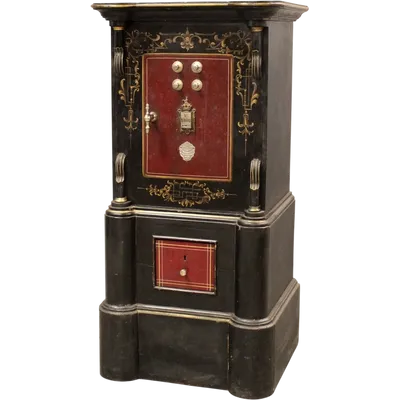
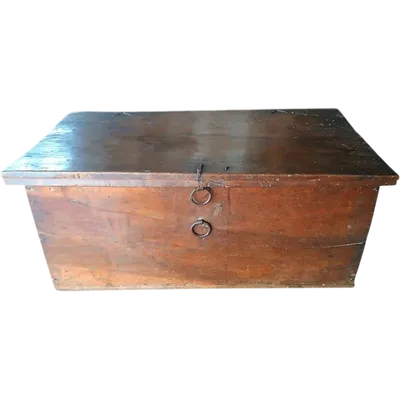
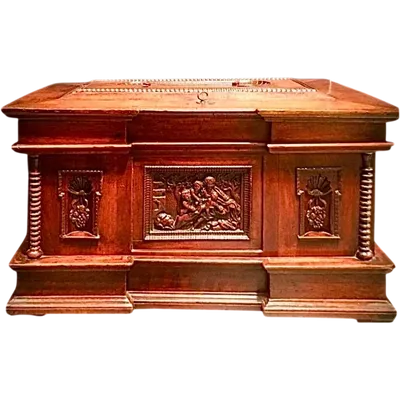
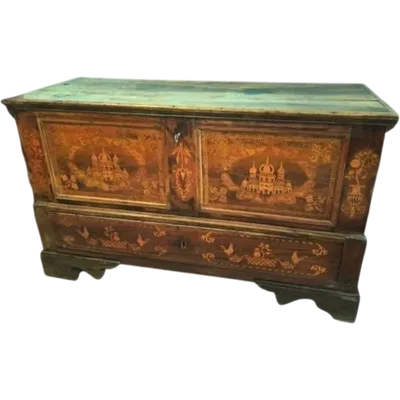
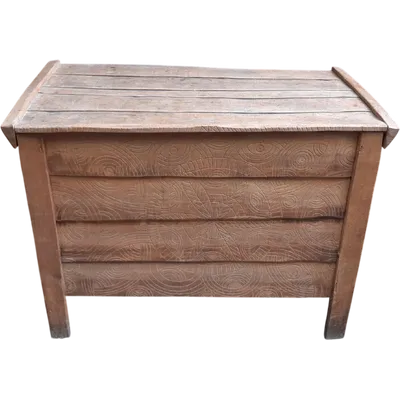
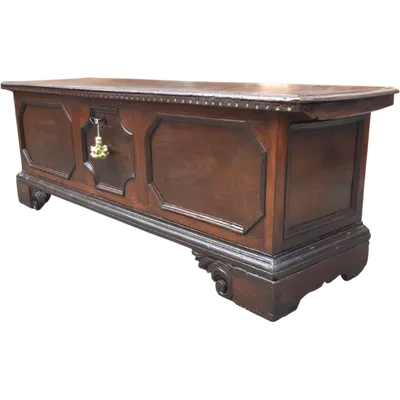
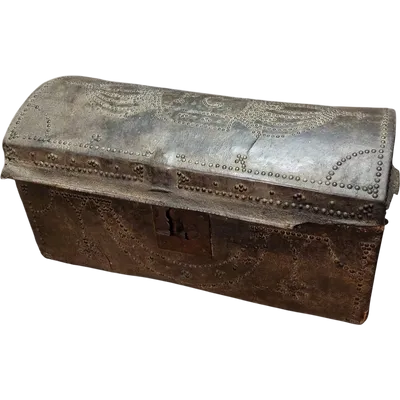
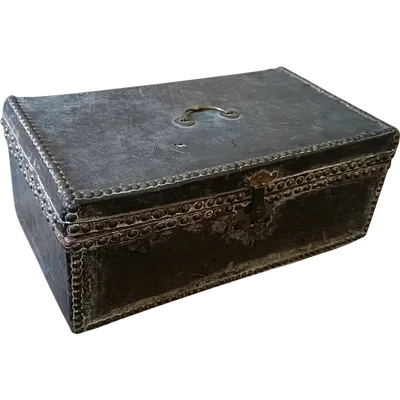
Antique Trunks, Chests and Cassoni
Origin and function
Trunks, storage benches and cassoni belong to one of the oldest families of furniture: horizontal storage pieces.
Before wardrobes, chests of drawers and sideboards became common, many objects were kept in chests, cassoni and containers closed by an upper lid. It was a simple, robust and versatile solution: it allowed textiles, clothes, linen, documents, personal objects and valuable goods to be protected.
The cassone is among the oldest and most important forms. In historic homes it could be used to keep dowry goods, linen or precious family objects. In some contexts, especially between the Middle Ages and the Renaissance, the cassone also took on a ceremonial and representative role, linked to marriage, dowry and family continuity.
The storage bench adds another use to this storage function: seating. It is a chest on which one can sit, often placed along a wall, in an entrance, kitchen, bedroom or passage area. It is a practical, domestic piece, often linked to everyday life.
The trunk, on the other hand, more directly recalls the idea of transport. It can be used at home, but it was often made to hold objects intended to be moved: clothes, personal belongings, documents, tools or goods. For this reason, many trunks have handles, metal reinforcements, strong locks and leather, canvas or metal coverings.
These pieces are interesting because they describe a very concrete relationship with objects: storing, protecting, transporting, concealing, organizing. They are simple forms, but rich in history.
Differences between trunk, storage bench and cassone
Trunk, storage bench and cassone are often grouped together, but they are not the same thing.
The trunk is generally a mobile container, designed to be transported or at least moved more easily than a large domestic piece of furniture. It may have a flat or domed lid, side handles, locks, reinforcements, studs and coverings. Travel trunks, in particular, often show signs of movement: worn corners, robust hardware, marked surfaces, labels or traces of old coverings.
The storage bench is instead more closely linked to the domestic interior. It has the form of a chest, but can also be used as a seat. For this reason, the solidity of the lid, structure and sides is important. Some storage benches are very simple, while others have a backrest, armrests, carved panels or front decoration.
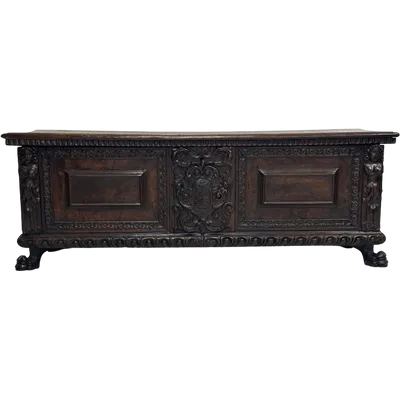
The cassone is often the most historical and representative piece among the three. It may be very simple or very rich. In the most important models, especially Renaissance or noble examples, the front can be decorated with carvings, coats of arms, paintings, gilding, carved architectural motifs or symbolic elements. In other cases, the cassone is more sober and linked to domestic life, while still preserving a strong historical identity.
The distinction is not always rigid. Some objects may sit somewhere in between: a storage bench may resemble a cassone, a trunk may have been used as a domestic container, and a cassone may have been adapted over time to new functions.
For this reason, it is useful to observe not only the name, but also the form, structure, lid, hardware, proportions and signs of use.
Main types
Antique trunks can be very different from one another.
Some are travel trunks, robust and designed to withstand movement. They may have a wooden structure covered in leather, canvas, metal or more recent technical materials. They often feature corner reinforcements, studs, locks, side handles and straps.
Other trunks are more domestic. Although they have the shape of a trunk, they were intended to hold linen, clothes or personal objects inside the home. In these cases they may be less reinforced and closer, in function, to chests and cassoni.
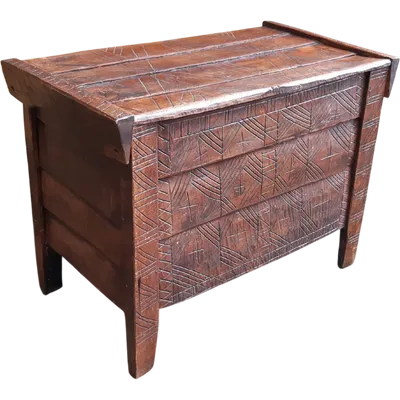
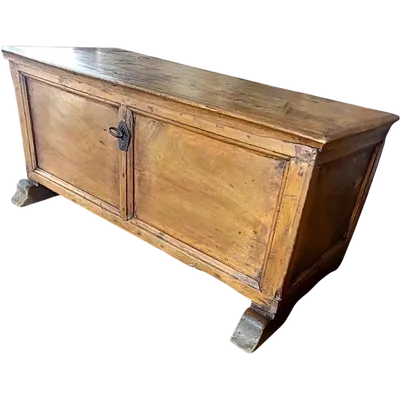
Storage benches may be simple chests with a flat lid, or more structured pieces. Some have a backrest, others side armrests, others a decorated front. In rustic contexts, the storage bench was often an everyday piece, used in the kitchen, entrance or sleeping area.
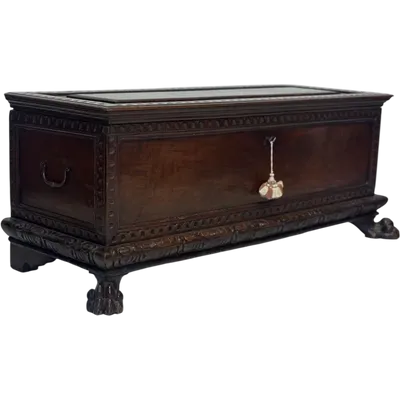
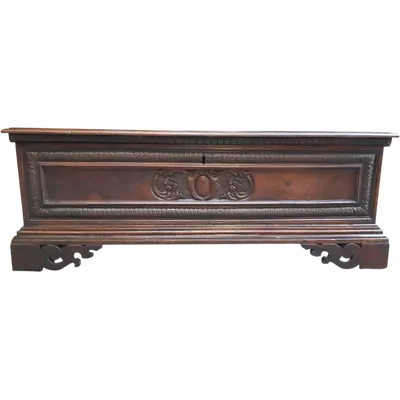
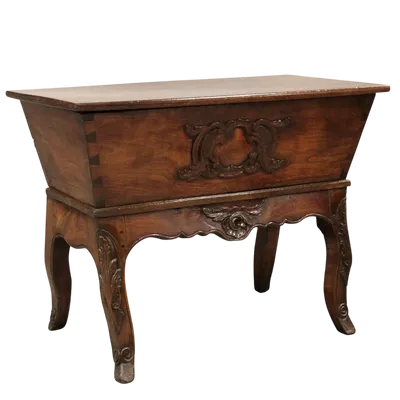
Antique cassoni may have a very different presence depending on period and quality. The most important cassoni may be carved, painted, gilded or decorated with coats of arms and heraldic motifs. Simpler examples may be made of solid wood, with front panels, sturdy feet and essential hardware.
There are also hybrid containers: dowry chests, travel chests, military trunks, sacristy cassoni, merchant chests, regional storage benches and work containers. In these cases, the original function is often essential for understanding the piece.
Styles and most recognizable forms
Trunks, storage benches and cassoni span many centuries, so they do not belong to a single style.
In the oldest cassoni, especially those of medieval or Renaissance taste, the structure is often solid and compact. The front may be enriched with panels, carvings, coats of arms, architectural motifs or painted decoration. In some examples, the piece is not merely a container, but also a sign of family prestige.
In the Baroque period, forms may become richer and more scenic. Deeper carvings, scrolls, vegetal decoration, marked cornices and greater plastic strength appear. Even a chest or cassone can take on an important presence in the room.
With Neoclassicism and Louis XVI taste, decoration tends to become more orderly. Forms become more geometric, panels more regular, motifs more inspired by antiquity: rosettes, garlands, fluting, stringing and more controlled proportions.
In the nineteenth century, both more bourgeois and decorative pieces and rustic or provincial examples became widespread. Storage benches may be simple and robust, while some trunks become increasingly linked to travel, transport and mobility.
Between the late nineteenth and early twentieth centuries, travel trunks changed profoundly. Covered, reinforced, more technical models appeared, connected to new railway and transatlantic mobility. At the same time, storage benches and domestic containers could follow Art Nouveau, rustic, eclectic or early twentieth-century taste.
Alongside the most recognizable styles, there is a broad regional and vernacular production. It is often less decorative, but very interesting for its relationship with the territory, local materials and everyday life.
Materials and surfaces
Wood is the main material of cassoni and storage benches.
In Italian furniture, walnut, chestnut, oak, poplar, fir, pine and cherry are often found. Walnut is frequent in more important and representative pieces. Chestnut and oak are appreciated for robustness and resistance. Poplar, fir and pine often appear in internal structures, painted furniture or everyday containers.
More refined cassoni may feature carvings, gilding, painted decoration, lacquer, coats of arms, stringing and carved panels. The front surface is often the most important, because it is the one intended to be seen.
Trunks may combine different materials. Leather, canvas, metal, iron, brass, studs, metal corner pieces, locks, straps and coverings may be added to the wooden structure. In travel trunks, these elements are not merely decorative: they serve to protect the container during movement.
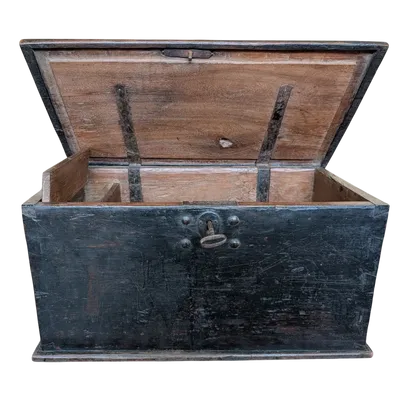
Hardware is often fundamental. Locks, hinges, handles, studs, reinforcements and nails reveal a great deal about the function and period of the object. Robust hardware worn in a coherent way may indicate intense practical use; hardware that is too new or too uniform may instead suggest recent replacements.
The interior is also important. The bottom, boards, possible coverings, compartments or traces of fabric can help understand how the object was used. In some trunks, old papers, canvas, interior linings or marks left by stored objects can still be found.
Construction techniques and details to observe
To evaluate antique trunks, storage benches and cassoni, one must look above all at the structure.
The lid is one of the main elements. It may be flat, domed, shaped or reinforced. It must be coherent with the body of the piece, with the hinges and with the function. A replaced or much more recent lid can significantly change the value of the object.
Hinges are equally important. In antique pieces they may be made of iron, robust and often fixed with nails or screws that are not perfectly regular. Modern hinges, too light or incompatible with the structure, may indicate a recent intervention.
The bottom should be observed carefully. It is one of the parts most subject to wear, humidity and replacement. In an antique cassone or storage bench it may be made of boards, with signs of workmanship, old nails, deformations or restorations. A completely new bottom is not necessarily a problem, but it must be declared and evaluated.
The front is often the most decorative part. Panels, carvings, mouldings, coats of arms, paintings or studs must be coherent with period and style. Decorations that are too regular, artificial patinas or elements applied in an unconvincing way may suggest a transformation or replica.
The interiors are also revealing. An internal surface that is too clean and uniform may be suspicious, especially if the exterior appears very old. On the contrary, signs of use, color differences, traces of linings and small irregularities can help read the history of the object.
As always, authenticity is not based on a single isolated detail. What matters is the coherence between structure, materials, hardware, patina, function and signs of use.
Patina, wear and restorations
Trunks, storage benches and cassoni are objects that often had an intense life.
Their function was practical: containing, protecting, transporting, being opened and closed many times. For this reason, signs of use are normal: worn edges, scratches, abrasions, wear around the lock, repaired hinges, reinforced bottoms and marked interior surfaces.
In travel trunks, wear can be particularly evident. Damaged corners, oxidized metal, dry leather, worn canvas, tired handles and old labels may tell the story of movement. These signs are not necessarily defects: if coherent, they can increase the charm of the object.
In storage benches, one must distinguish between decorative wear and functional wear. A seat may show natural wear, but it must remain stable. A lid may have abrasions and marks, but it must open and close correctly. The bottom may have been reinforced, but should not compromise the legibility of the piece.
In older cassoni, patina is particularly important. Surfaces that are too uniform, very glossy polishing or restorations that erase every trace of time can reduce historical interest.
The most common restorations concern lids, hinges, locks, feet, bottoms, handles, coverings and structural parts. These are normal interventions, especially on objects still intended for use. The point is to understand whether the restoration has preserved the nature of the object or transformed it excessively.
A good restoration makes the piece stable and usable. An invasive restoration, instead, can erase patina, replace too many parts or make the object more “decorative” than authentic.
Italian, French and regional trunks, storage benches and cassoni
In Italy, cassoni and storage benches have a very rich tradition.
Italian Renaissance cassoni, especially in important contexts, may have strong symbolic and decorative value. In regional and rustic furniture, instead, local woods, solid forms and a more domestic function often prevail.
Italian storage benches vary greatly from region to region. Some are simple and robust, while others have carved fronts, decorated panels, backrests or armrests. In Tuscany, Veneto, Lombardy, Piedmont and other areas, different traditions can be found in materials, proportions and decoration.
In France, storage benches, coffres and trunks may be linked both to domestic life and to travel. In more refined models, elegant forms, panels, carvings and carefully made hardware can be found. In travel trunks, instead, practical function often becomes dominant.
Provenance must always be evaluated on the individual object. A trunk may have been produced in one country, used in another and modified over time. A cassone may revive antique models while being later in date. A rustic storage bench can be difficult to place without observing materials, construction and details.
Choosing a trunk, storage bench or cassone for a contemporary interior
Trunks, storage benches and cassoni also fit easily into contemporary interiors, because they have simple forms and still-current functions.
An antique trunk can be placed at the foot of a bed, in an entrance, in a living room or under a window. It can hold blankets, textiles, seasonal objects or documents, or function as a decorative element. Some travel trunks, especially those with visible coverings and hardware, have a strong scenic presence.
A storage bench can be very useful in an entrance, kitchen, bedroom or passage area. It offers seating and storage at the same time. It is important, however, to check its height, stability and actual comfort.
An antique cassone may have a more historical and important presence. It can work in a bedroom, salon, study or representative interior. If it is highly decorated or particularly old, it may be better valued as a main piece, avoiding overly intensive use.
From an aesthetic point of view, these pieces also work well by contrast. A worn trunk can warm up a minimalist interior. A rustic storage bench can make a modern space feel more natural. An important cassone can give historical depth to a simple room.
The choice depends on three aspects: function, dimensions and state of conservation. A horizontal storage piece is beautiful when it feels natural in the space, while remaining practical to use.
Authenticity and value
The value of antique trunks, storage benches and cassoni depends on period, quality, materials, provenance, rarity, state of conservation, original function and level of restoration.
A decorated antique cassone may have great historical value, especially if it preserves original parts, patina, hardware and coherent decoration. A rustic storage bench may be less rare, but very interesting if authentic, well proportioned and preserved with balance. A travel trunk may be appreciated for materials, maker, provenance, construction details and traces of use.
Authenticity must always be assessed as a whole. An object may have restored parts without losing interest. It becomes more problematic when lid, bottom, hardware, coverings or decorations have been extensively replaced and not declared.
For the buyer, it is useful to observe first the general form, then the function, then the materials, and then hardware, hinges, bottom, interiors and patina. They are simple objects only in appearance: in reality, precisely because they have an essential structure, every detail says a lot.
Antique trunks, storage benches and cassoni still preserve a particular strength today. They were created to protect what had value in everyday and family life, and for this reason they carry with them a sense of memory, solidity and domestic continuity.
Frequently asked questions
What are antique trunks, storage benches and cassoni?
Antique trunks, storage benches and cassoni are generally horizontal storage pieces, used to keep clothes, linen, textiles, personal objects or valuable goods. Although they share similar functions, they differ in form, use and context: the trunk is often linked to travel, the storage bench combines storage and seating, while the cassone has a long domestic and ceremonial tradition.
What is the difference between a trunk, a storage bench and a cassone?
A trunk is a portable container, often with a domed lid or metal reinforcements, also intended for travel. A storage bench is a chest that also functions as a seat, often placed in entrances, bedrooms or domestic interiors. A cassone is an older and more important storage piece, often linked to the preservation of linen, dowry goods or representative functions.
What were antique cassoni used for?
Antique cassoni were used to store textiles, linen, clothes and valuable objects. In some contexts, especially Renaissance and noble interiors, they could be connected to the bridal dowry and take on strong symbolic and decorative value.
Which styles are most common in antique trunks, storage benches and cassoni?
Examples can be found in Renaissance, Baroque, Neoclassical, Empire, rustic, provincial, Art Nouveau and early twentieth-century taste. Older cassoni often feature carvings, coats of arms, panels and painted decoration; trunks often include reinforcements, studs, locks and coverings.
What materials are most commonly found?
The most common materials are walnut, oak, chestnut, poplar, fir, pine and cherry. Trunks may include leather, canvas, iron, brass, studs and metal reinforcements. More refined cassoni may feature carvings, lacquer, gilding, painted decoration or elaborate hardware.
How can you recognize an authentic antique trunk or cassone?
It is useful to observe the structure, wood, hardware, lid, bottom, hinges, lock, patina and signs of use. An authentic object shows consistency between materials, construction techniques, wear and original function. Interior and lower parts are often more revealing than external surfaces.
Were antique trunks always used for travel?
Not always. Many trunks were indeed designed to transport clothes and personal objects, but others had a domestic function. The presence of side handles, reinforcements, coverings, strong locks and signs of movement may indicate travel-related use.
Can antique storage benches still be used today?
Yes, many antique storage benches can still be used as containers, entrance benches, pieces at the foot of a bed or decorative furniture. However, it is important to check stability, lid, hinges, bottom and seat resistance.
Do restorations reduce the value of antique trunks, storage benches and cassoni?
Not necessarily. Consolidation, correct cleaning, repair of hinges or small structural interventions can be normal. Invasive restorations, extensive replacements, incoherent hardware or overly uniform surfaces can instead reduce the historical interest of the object.
How should you choose an antique trunk, storage bench or cassone?
It is useful to evaluate function, dimensions, state of conservation, lid opening, stability, materials and intended context. A trunk may be suitable as a decorative container, a storage bench also as seating, while an antique cassone may have a more historical and representative presence.