
Antique Corner Cabinets
Read the guideSave search
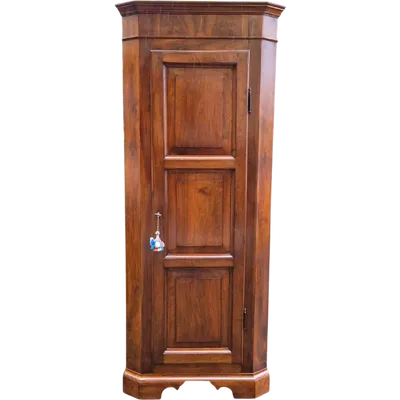
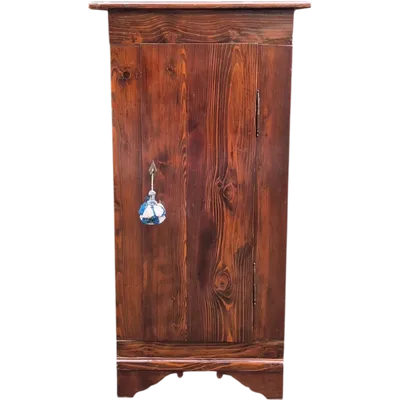
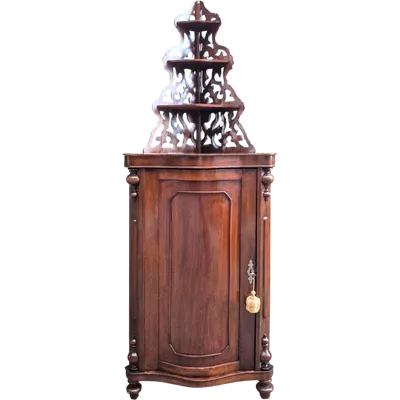
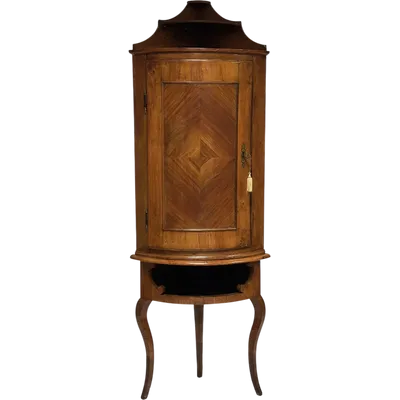
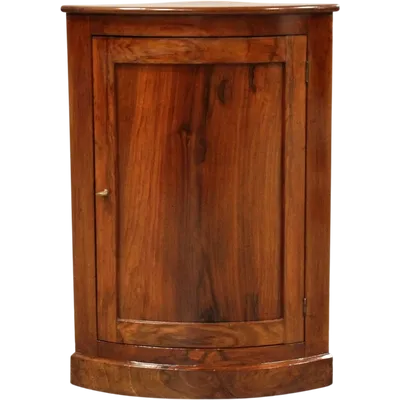
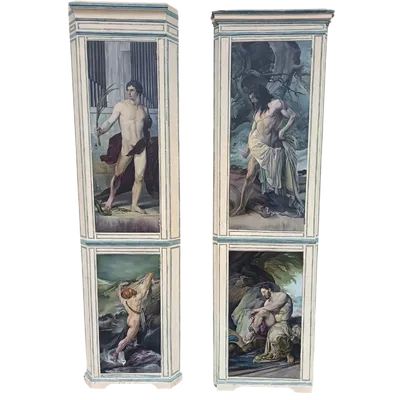
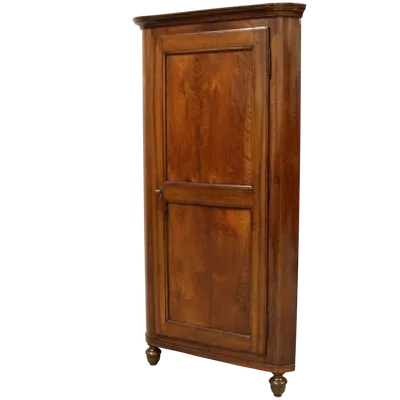
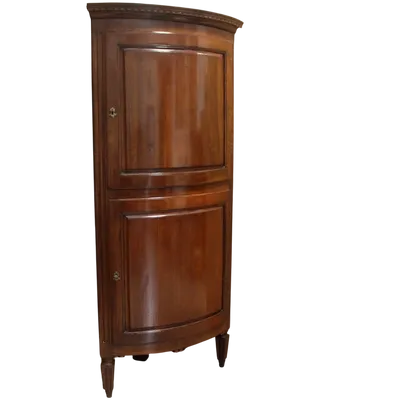
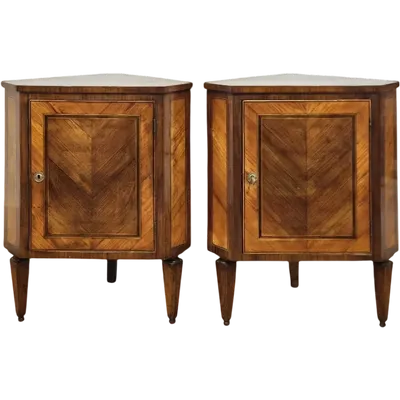
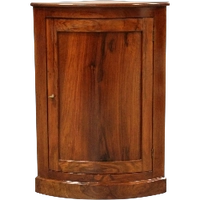
Antique Corner Cabinets
Origin and function of corner cabinets
The corner cabinet was born from a very practical need: making use of the corners of the home.
In a room, the corner is often a difficult space to furnish. It is not a full wall, it is not a visual center, and it is not always suitable for deep or bulky furniture. The corner cabinet solves exactly this problem: it transforms a marginal point of the room into a useful, orderly and often decorative space.
Its shape is designed to adapt to the meeting point between two walls. For this reason, many corner cabinets have a triangular structure, a quarter-round shape or a shaped front. Some are tall and vertically developed, while others are lower and more compact. Some stand on the floor, others are wall-mounted and fixed to the wall.
From a functional point of view, a corner cabinet can be used for storage or display. In dining rooms, it could hold tableware, glasses, ceramics or silverware. In living rooms, it could display decorative objects, small books, porcelain or curiosities. In more rustic or provincial interiors, it often had a practical and everyday function.
It is an interesting piece precisely because it combines usefulness and discretion. It does not dominate the room like a large wardrobe or monumental sideboard, but works along the margins of the space, completing it.
The main types of corner cabinets
Antique corner cabinets can take different forms, but some types appear more frequently.
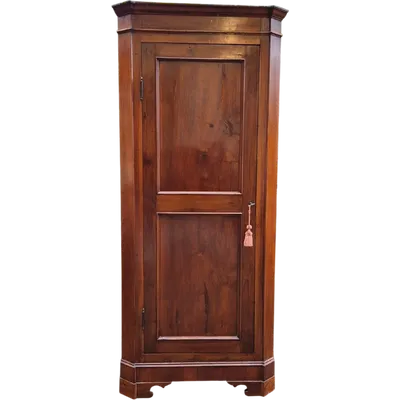
The most common is the floor-standing corner cabinet, developed in height and resting directly on the floor. It may be entirely closed by doors, or have a closed lower section and an open or glazed upper section. This type of furniture is particularly suitable for interiors where storage is needed without occupying too much wall space.
The glazed corner cabinet, on the other hand, has a more display-oriented function. Glazed doors allow ceramics, glasses, glassware, small objects or collections to be shown. In these cases, glass is not only a practical element, but also contributes to the visual lightness of the piece.
The wall-mounted corner cabinet is smaller and fixed to the wall. It may be closed, open or glazed. It is often more decorative than capacious, and is well suited to small objects. In antique interiors, it could be used in kitchens, reception rooms, small studies or private spaces.
There are also open corner cabinets, with exposed shelves and no doors. They are lighter and more decorative, but also more exposed to dust and less suitable for storing delicate objects. Their quality depends greatly on proportions, shelf design and the care given to the cornices.
Some more refined examples combine several functions: closed lower section, glazed upper section, shaped cornice, moulded frames, small drawers, internal mirrors or painted decoration.
Styles and most recognizable forms
Corner cabinets often follow the taste of the furniture of their time, but in a more compact form adapted to their function.
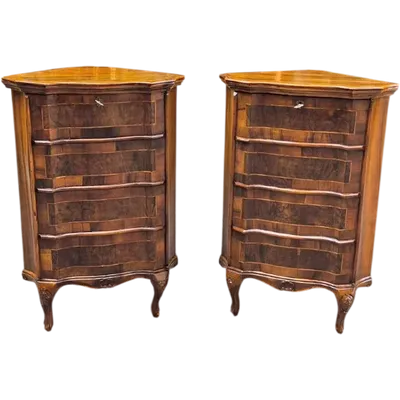
In the eighteenth century, especially in the Louis XV and Rococo taste, one finds corner cabinets with flowing lines, curved or slightly bombé fronts, shaped feet and softer cornices. These are pieces that seek elegance and lightness, even when they have a practical function.
With Louis XVI and Neoclassicism, forms become more ordered and geometric. Lines become straighter, cornices more regular, and decoration more measured. Stringing, small inlays, classical motifs and more controlled proportions may appear.
In the nineteenth century, corner cabinets become very varied. Some examples revive earlier styles, such as Louis XV, Louis XVI, Baroque or Renaissance. Others belong to a more bourgeois, rustic or provincial taste, with simple forms, local woods and restrained decoration.
In Art Nouveau or early twentieth-century corner cabinets, more fluid lines, vegetal motifs, decorative glass or lighter proportions may appear. In these cases, the piece does not merely seek to contain, but also participates in the decorative atmosphere of the room.
Alongside the more recognizable styles, there are many regional or vernacular corner cabinets. They are often less monumental, but very interesting for their relationship with local materials, construction simplicity and domestic function.
Materials and surfaces
As in many antique pieces of furniture, wood is the main material in corner cabinets.
In Italy, corner cabinets are often found in walnut, chestnut, cherry, oak or poplar. Walnut is frequent in more refined or representative pieces, while chestnut and cherry often appear in regional, rustic or provincial furniture.
Oak is more common in certain Nordic, French, English or Central European productions, and is appreciated for its solidity and material presence. Mahogany appears especially in more elegant, nineteenth-century or English-influenced furniture.
In more refined examples, the surface may be enriched with veneers, burr woods, stringing or small inlays. In other cases, the piece may be lacquered or painted, especially in Venetian, Nordic or rustic productions.
Glass is an important element in glazed corner cabinets. Antique glass panes may show slight waves, small imperfections or less uniform transparency than modern glass. These characteristics are not defects: they often contribute to the charm and historical coherence of the piece.
Hardware also deserves attention. Hinges, locks, escutcheons and handles should be observed carefully, because they can help understand the period, quality and possible restorations. Replaced hardware is not necessarily a problem, but it should be coherent in form, material and proportions.
Construction techniques and details to observe
To evaluate an antique corner cabinet, it is useful not to stop at the front.
The back is one of the most important elements. Since the corner cabinet was made to stand against two walls, the back may be less finished than the visible part. Precisely for this reason, it can preserve valuable information: original boards, nails, plane marks, joints, traces of old fixings or restorations.
The interior should also be observed carefully. Shelves may be original or replaced. Grooves, supports, holes and differences in color can indicate changes made over time. In some cases, a corner cabinet originally made as a closed piece may have been transformed into a display cabinet, or a larger piece may have been adapted to a new function.
Doors are another fundamental point. Hinges, locks, rebates, frames and alignment should be examined. In an antique piece it is normal to find small irregularities, but doors that are very misaligned or difficult to close may indicate structural issues, deformation or poorly executed restorations.
In the case of glazed corner cabinets, it is also important to check the glass and the way it is fixed. Very modern, perfectly uniform glass or glass mounted with recent techniques may indicate a replacement. This is not always negative, but it should be considered in the overall evaluation.
As with all antique furniture, a single detail taken in isolation is not enough. What matters is the overall coherence between structure, materials, hardware, patina and function.
Patina, wear and restorations
The corner cabinet is a piece of furniture that often lives in a relatively protected position, because it is placed in a corner. For this reason, wear may be less visible than on a table, chair or chest of drawers used every day.
However, even an authentic antique corner cabinet shows signs of age. One may find slight abrasions on the edges, wear around locks or handles, color differences on the shelves, traces left by objects placed on them, small deformations of the wood or variations in the surface.
The patina should appear coherent. An antique piece of furniture rarely has surfaces that are all identical, shiny and perfectly uniform. Areas more exposed to light, contact or cleaning may differ from internal or hidden areas.
The most common restorations concern shelves, locks, hinges, glass, feet, cornices or small missing parts. In some cases, bottoms may have been replaced or the structure reinforced. These are normal interventions, especially in furniture still intended for use.
The point is to understand how much the restoration respected the piece. A conservative intervention keeps the object’s history legible. An overly invasive restoration, instead, can make the piece excessively uniform, erase the patina or alter proportions and function.
Italian, French and regional corner cabinets
Italian corner cabinets are very varied, because they reflect different regional traditions.
In more refined models, one may find walnut, inlays, shaped cornices and elegant proportions. In more rustic or provincial productions, local woods, simple forms and more direct construction prevail. These less monumental corner cabinets can be very interesting precisely for their domestic authenticity.
French corner cabinets often show strong attention to form and decoration. In Louis XV models, flowing lines, shaped doors and softer profiles may appear. In Louis XVI models, proportions become more geometric and ordered, with regular cornices and more sober decoration.
Nordic, English or Central European productions may show a more functional character, with light woods, oak, painted finishes or more severe forms. In these cases, the piece may be less decorative, but very balanced in its construction and use of space.
Naturally, provenance must always be evaluated on the individual object. A piece may have been influenced by foreign fashions, modified over time or made locally following models widespread in other areas.
Choosing a corner cabinet for a contemporary interior
The corner cabinet is a particularly interesting piece in contemporary interiors, because it makes it possible to use areas of the home that are often neglected.
It can enhance an empty corner of the living room, complete a dining room, lighten a study or create a small display point. Compared to a sideboard or traditional bookcase, it occupies less visual space and can be integrated more discreetly.
A glazed corner cabinet may be suitable for ceramics, glasses, glassware or small collectible objects. A closed corner cabinet may be more useful for storing less decorative items. A wall-mounted corner cabinet can work well in small rooms, entrances, kitchens or studies.
Proportions, however, must be evaluated carefully. A tall, dark corner cabinet in a small room may feel heavy, while in a bright interior it can become an elegant and orderly element. A highly decorated model needs space around it to be read properly. A simpler model can integrate more naturally.
The choice therefore depends on three elements: the available space, the desired function and the relationship with the other furnishings.
Authenticity and value
The value of an antique corner cabinet depends on period, construction quality, materials, state of conservation, provenance, rarity, proportions and level of restoration.
A corner cabinet is not necessarily more important because it is highly decorated. Some simple, well-proportioned and coherently preserved models may be more interesting than showy examples that have been heavily restored.
Authenticity must be assessed by observing the whole. An antique piece may have replaced glass, small restorations or remade shelves without losing all interest. It becomes more problematic when replacements are numerous, undeclared or alter the original function and appearance.
For the buyer, the best approach is to look progressively: first at the general form, then the proportion, then materials and details, and finally the hidden parts. An authentic corner cabinet does not need to appear perfect, but it must tell a coherent story.
It is precisely this combination of function, measure and discretion that still makes the antique corner cabinet an interesting piece today: it was created to occupy a marginal space, but can become a highly distinctive element of the interior.
Frequently asked questions
What is an antique corner cabinet?
An antique corner cabinet is a piece of furniture designed to be placed in the corner of a room, often with a triangular or shaped structure. It may have a storage or display function and is used to hold tableware, books, decorative objects or small valuable items.
What were antique corner cabinets used for?
Corner cabinets were created to make use of the corners of a room, turning an otherwise secondary space into a useful and decorative area. They were used in dining rooms, living rooms, studies and representative interiors.
What are the main types of antique corner cabinets?
The most common types are closed corner cabinets with doors, glazed corner cabinets, wall-mounted corner cabinets and open models with exposed shelves. Some examples combine a closed lower section with a glazed or open upper section.
Which styles are most common in antique corner cabinets?
Antique corner cabinets may belong to different styles, including Louis XV, Louis XVI, Neoclassical, Empire, Restoration, Art Nouveau and rustic or provincial taste. The style can be recognized through proportions, profiles, decoration, feet, cornices and hardware.
What materials are found in antique corner cabinets?
Antique corner cabinets are often made of walnut, cherry, oak, chestnut, mahogany or painted woods. More refined examples may include veneers, inlays, cut glass, mirrors, bronzes, brass hardware and painted decorations.
How can you recognize an authentic antique corner cabinet?
An authentic corner cabinet shows consistency between structure, materials, hardware, patina and construction techniques. It is useful to observe the back, shelves, joints, hinges, glass and interior areas, where signs of age are often better preserved.
Are antique corner cabinets always floor-standing pieces?
No. There are floor-standing corner cabinets, which are more structured and spacious, and wall-mounted corner cabinets, which are lighter and designed to be fixed to the wall. Wall-mounted corner cabinets are often used to display small objects, ceramics or glassware.
Can an antique corner cabinet have restored parts?
Yes, this is quite common. Shelves, locks, hinges, glass or small structural parts may have been restored or replaced. What matters is that the interventions are declared and coherent with the piece.
How should you choose an antique corner cabinet?
It is useful to evaluate dimensions, depth, height, door opening, state of conservation and intended function. A corner cabinet must fit the available corner well and maintain harmonious proportions in relation to the room.
Do original glass panes increase the value of a corner cabinet?
Original glass panes, especially if antique, cut or slightly irregular, can increase the interest of the piece. However, replaced glass is not necessarily a problem, provided the intervention is correct and declared.